

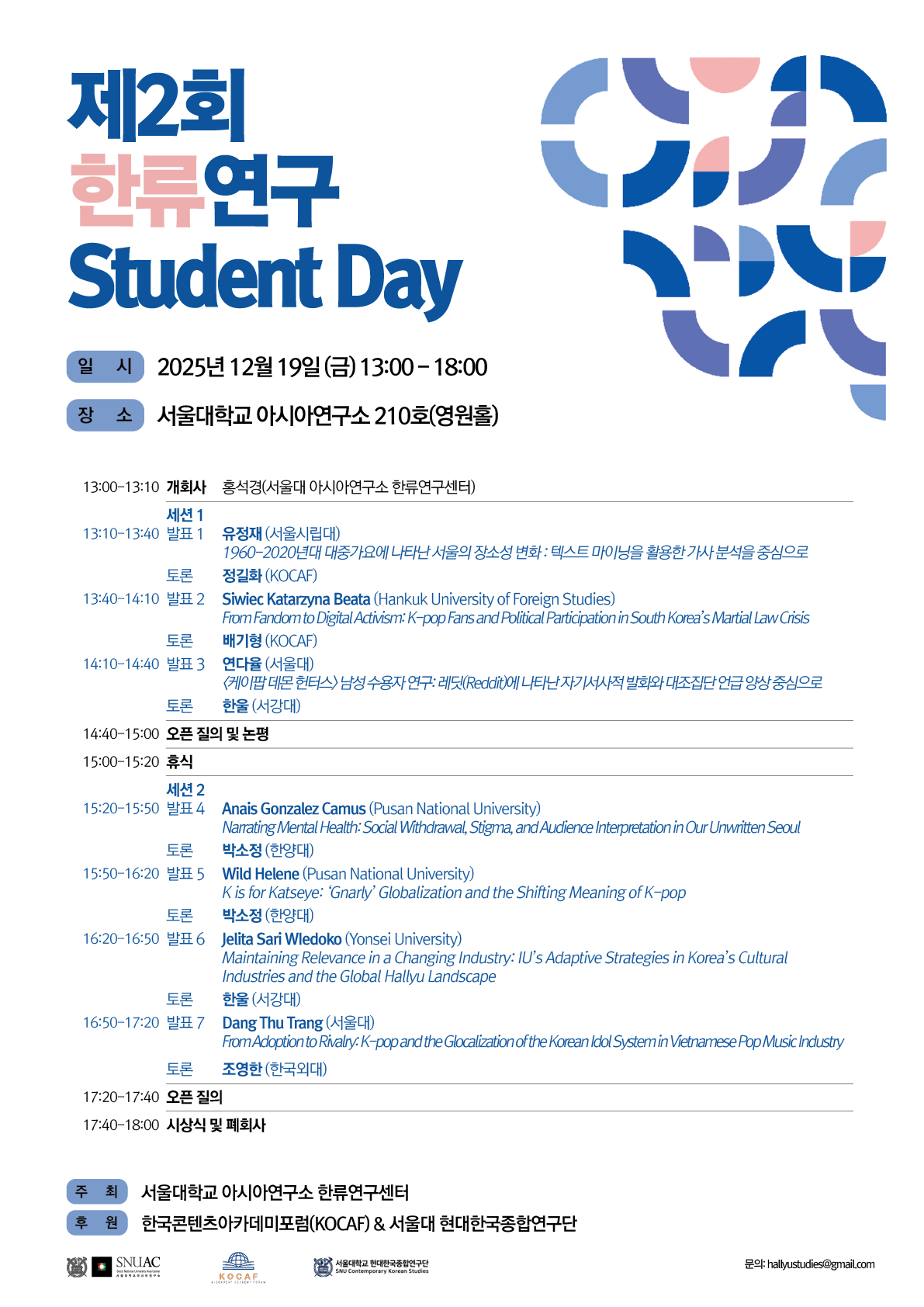
On December 19, 2025, the 2nd Hallyu Student Day was held in Room 210 (Young-One Hall) of the Seoul National University Asia Center. The event was hosted by the Center for Hallyu Studies at the Seoul National University Asia Center and sponsored by the Korea Contents Academy Forum (KOCAF) and the SNU Contemporary Korean Studies. This event was organized to share the academic achievements of student researchers on the themes of Korean popular culture and the Hallyu phenomenon, and to discover and encourage the next generation of Hallyu scholars, marking its second year following the inaugural event. Accordingly, through a process of preliminary presentation applications and paper submissions, a total of seven student researchers were selected to present their research and engage in discussions with discussants and the audience on the day of the event.
The event began with opening remarks by Seok-Kyeong Hong, a professor in the Department of Communication at Seoul National University, Director of the Center for Hallyu Studies, and Director of Global Hallyu Team at SNU Contemporary Korean Studies and consisted of two sessions. In the first session, three presentations were delivered, focusing on methodological experiments applicable to Hallyu studies and audience studies. Jeong-jae Yoo (University of Seoul) examined the changes in the “placeness” of Seoul appearing in popular songs from the 1960s to the 2020s through text-mining-based lyric analysis, while Siwiec Katarzyna Beata (Hankuk University of Foreign Studies) analyzed the political participation and digital activism of K-pop fandoms emerging during South Korea’s martial law crisis. Da-yul Yeon (Seoul National University) examined the patterns of male consumption of K-pop vicarious (reaction) content on Reddit, focusing on the characteristics of self-narrative discourse and mentions of contrast groups. Gil-Hwa Jung (KOCAF), Kihyung Bae (KOCAF), and Oul Han (Sogang University) participated as discussants to lead in-depth discussions.
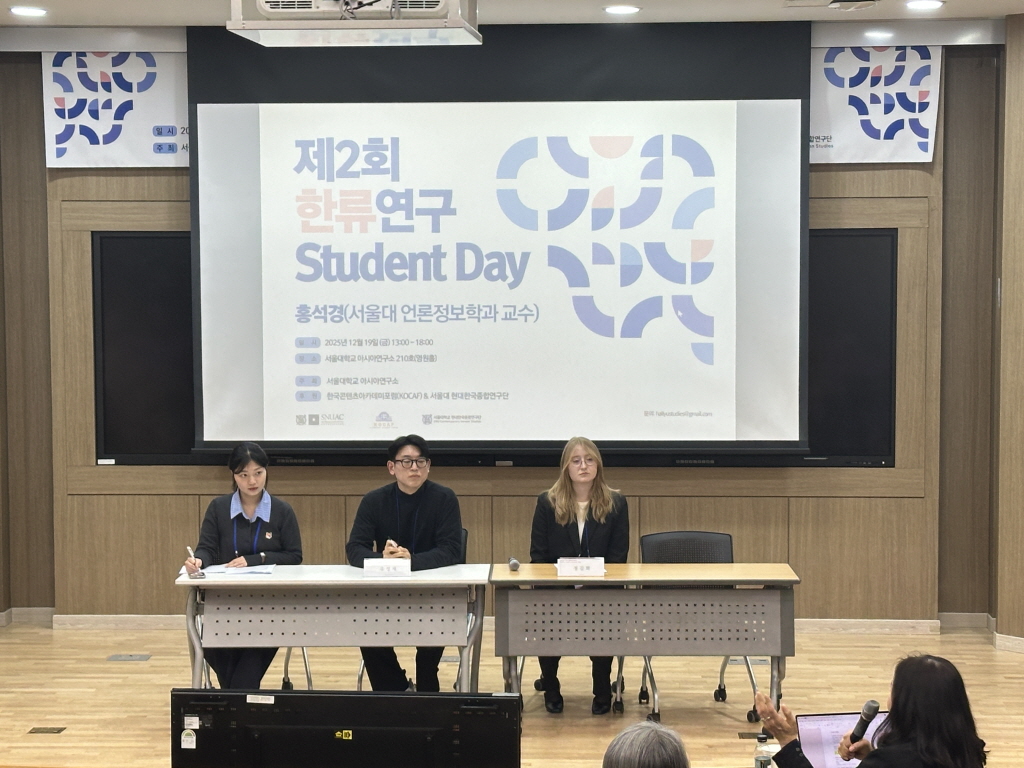
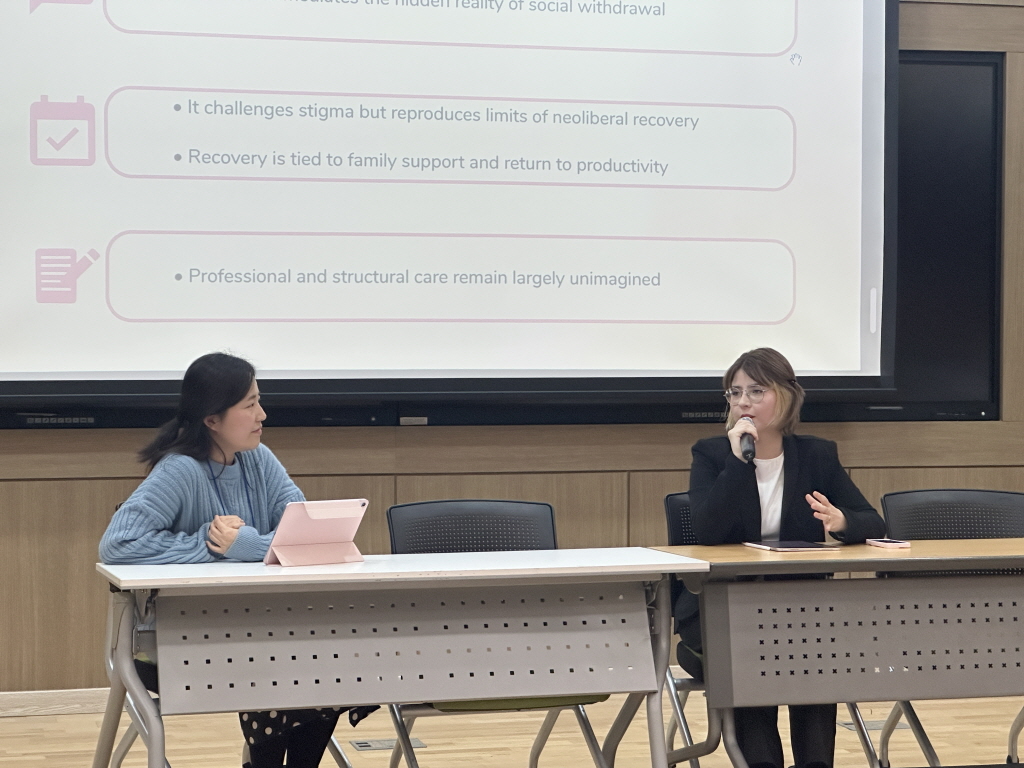
In the second session, the narrative, industrial, and reception aspects of global Hallyu were intensively addressed, centering on K-pop and dramas. Anais Gonzalez Camus (Pusan National University) analyzed the representation of mental health narratives and viewer interpretations, focusing on the drama The Unknown Seoul, and Wild Helene (Pusan National University) explored the “gnarly” globalization of K-pop and its change in meaning through the case of K is for Katseye. Jelita Sari Wiedoko (Yonsei University) analyzed IU’s adaptation strategies amidst the changing environment of the Korean cultural industry and discussed sustainability in the global Hallyu landscape, while Dang Thu Trang (Seoul National University) analyzed the adoption of the K-pop idol system and the competitive structure appearing in the Vietnamese popular music industry. Sojeong Park (Hanyang University) and Younghan Cho (Hankuk University of Foreign Studies) expanded the theoretical and empirical significance of the research through their respective commentaries.
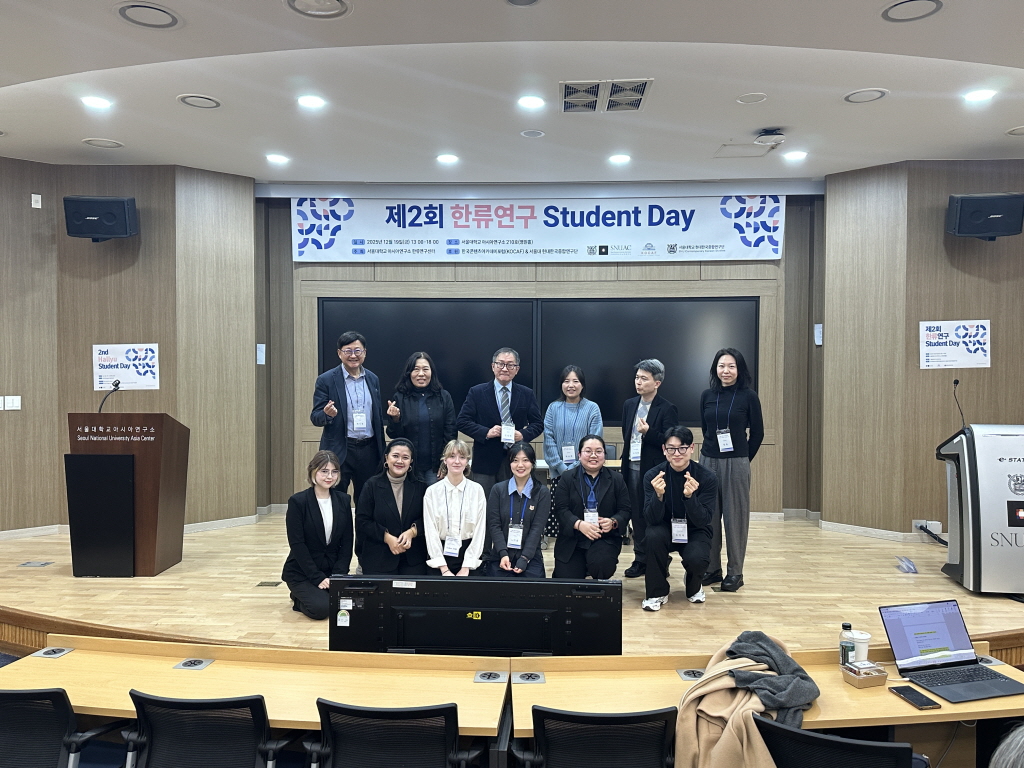
The Grand Prize was awarded to Dang Thu Trang, a student at Seoul National University. Her paper, “From Adoption to Rivalry: K-pop and the Glocalization of the Korean Idol System in Vietnamese Pop Music Industry,” started from the critical awareness that existing research on the globalization of Hallyu has remained within the dichotomy of cultural imperialism and audience-centered analysis. She analyzed how cultural industries in the Global South actively appropriate and reconstruct the Hallyu model through the case of the Vietnamese popular music industry (V-pop). In particular, she noted that the Vietnamese music industry has gone beyond simply consuming K-pop and has strategically introduced and modified the industrial organizational logic known as the “idol system.”
The 2nd Hallyu Student Day was an occasion to confirm the potential for expansion in Hallyu studies through various methodologies such as text mining, digital ethnography, industrial analysis, and audience research. In particular, the critical awareness of student researchers crossing regions, platforms, and industries, combined with active discussion, once again demonstrated the interdisciplinary potential of Hallyu studies. It is expected that through the annual Hallyu Student Day, more young researchers will be discovered and the horizons of Hallyu studies will continue to expand.