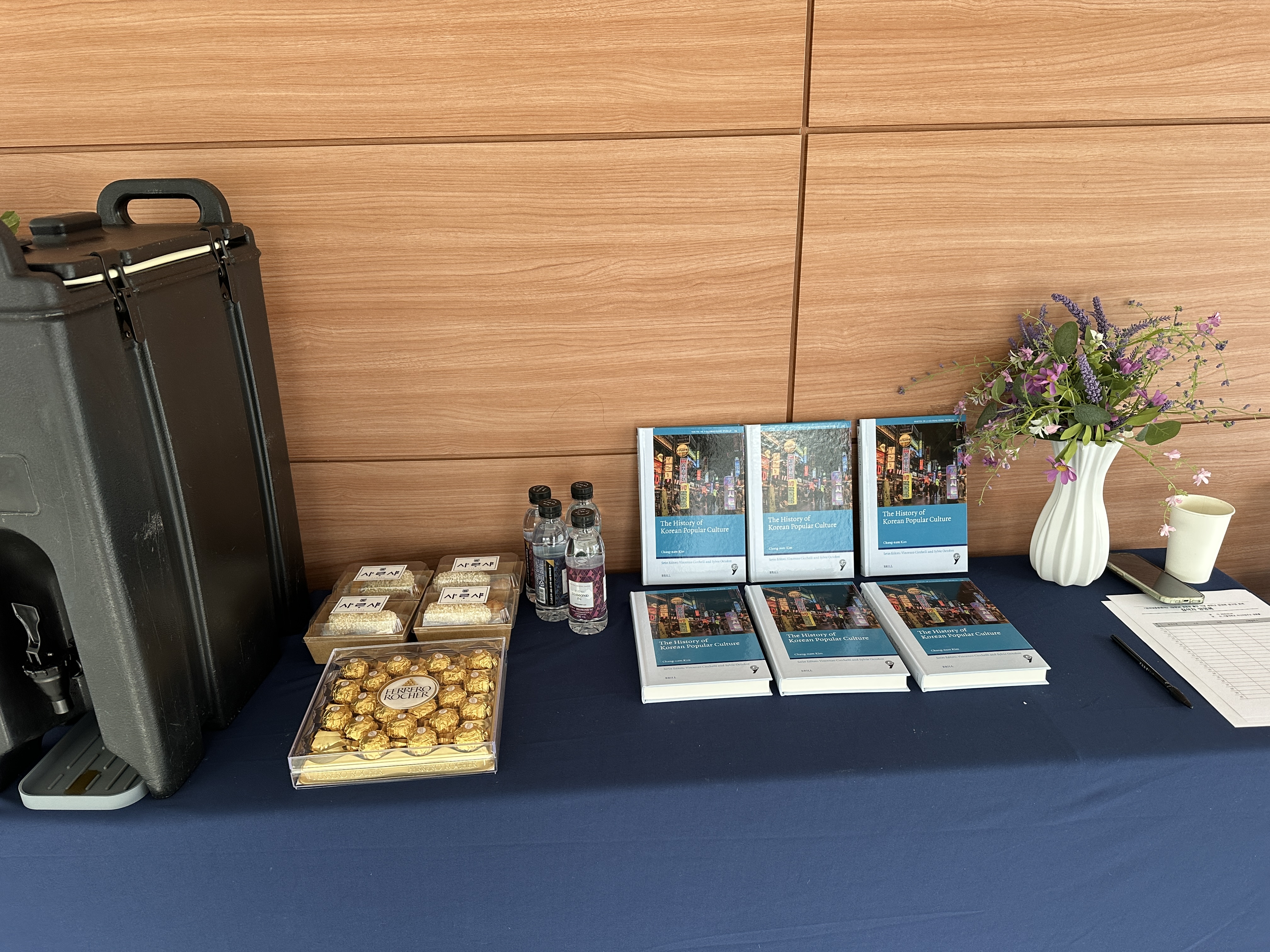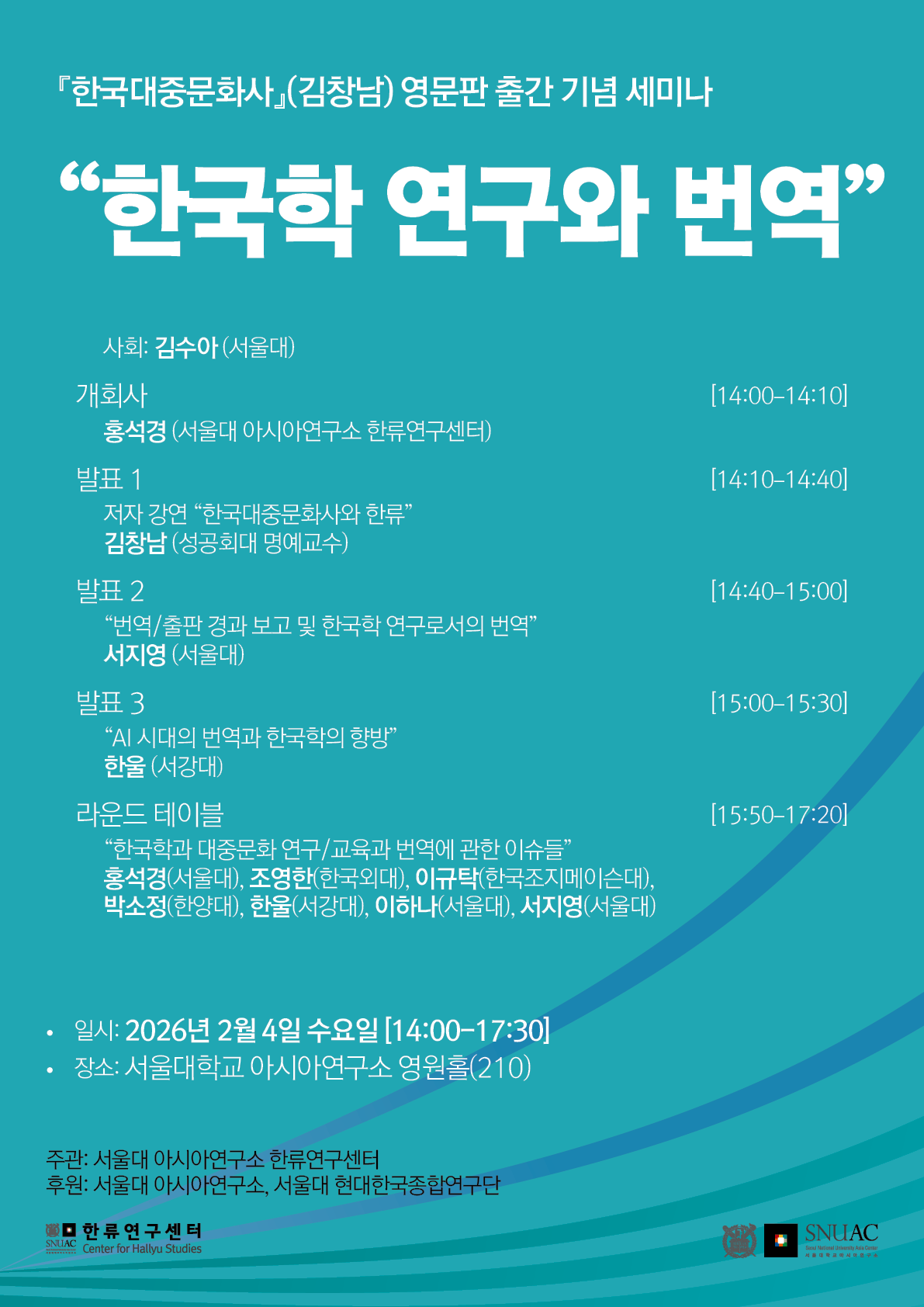
On February 4, 2026, the seminar “Korean Studies Research and Translation,” commemorating the publication of the English edition of The History of Korean Popular Culture (Chang-nam Kim), was held at Young-one Hall in the Seoul National University Asia Center (SNUAC). This event was organized to celebrate the English release of the work by Professor Chang-nam Kim, a leading authority on Korean popular culture research, and to discuss the role of translation and the re-contextualization of Korean Studies knowledge within a global environment.
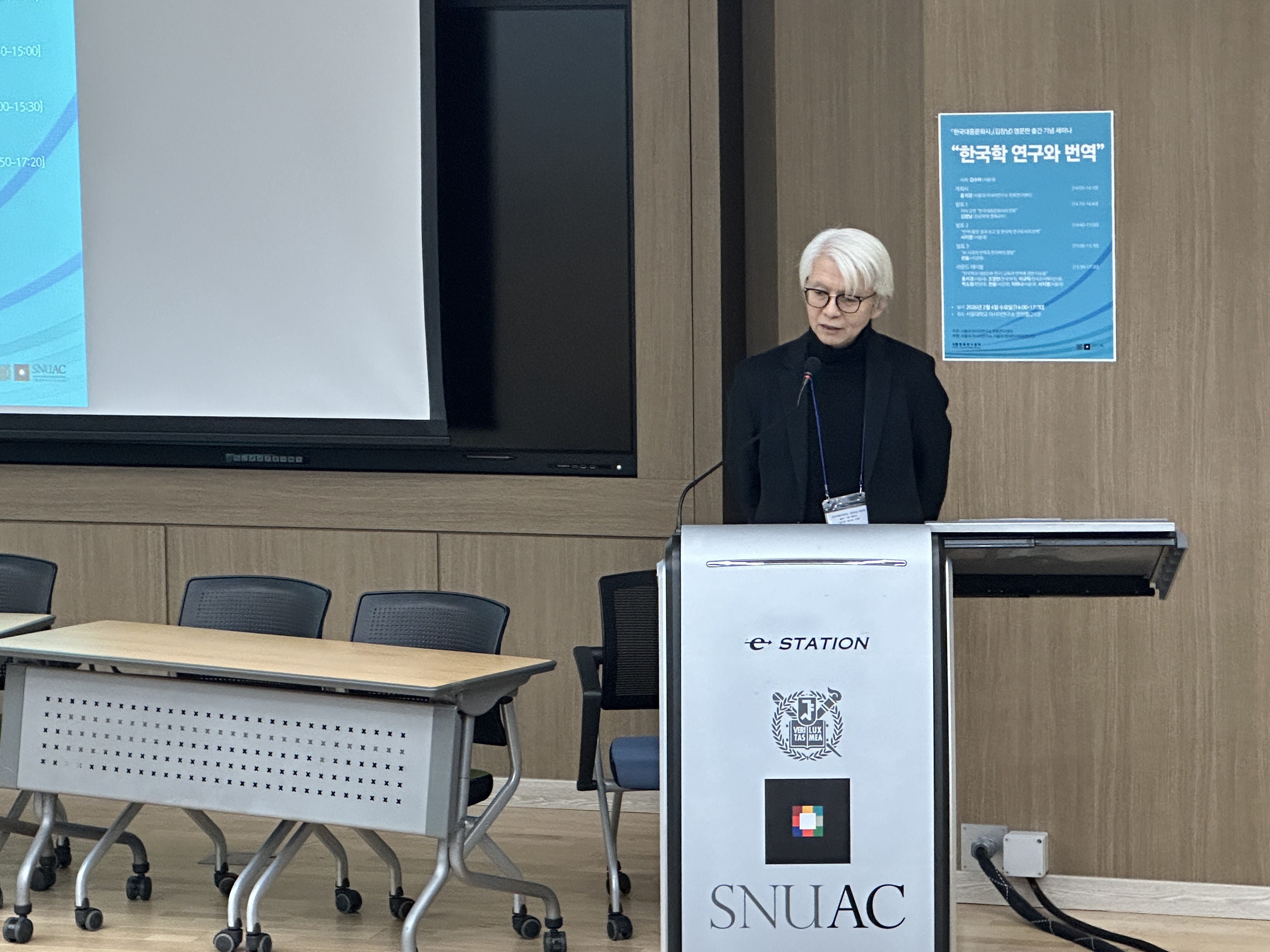
Opening the event, Professor Emeritus Chang-nam Kim (Sungkonghoe Univ.) delivered an author's lecture explaining the motivation behind writing A History of Korean Popular Culture and the historical trajectory of Korean popular culture. Professor Kim shared that this book stemmed not from a grand academic ambition but from a process of tracing his personal memories and identity related to the movies, comics, and songs he enjoyed since childhood. He emphasized that popular culture changes in close alignment with a society's political and economic conditions, analyzing that the fundamental driver of the current global success of K-pop and Hallyu lies in the democratization achieved in modern Korean history. His core argument was that creative content production became possible thanks to a democratic soil where the power of censorship weakened and the public’s desire for self-expression could burst forth.
In the following session, Professor Jiyoung Suh (SNU) presented the specific progress of the project under the theme “Report on the Progress of Translation/Publication and Translation as Korean Studies Research.” The Center for Hallyu Studies at the SNU Asia Center was selected for the 'Korean Academic Translation Project,' a part of the Korean Studies Promotion Program, and has been conducting English translations for the "Korean Popular Culture Series" from November 2022 to June 2026. Introducing the publication process of A History of Korean Popular Culture, published by Brill in October 2025 as the first result, she explained the systematic division of labor involving the author, research team, native-speaker supervisors, and the publisher’s editing team. Furthermore, she emphasized that this translation holds academic significance beyond a simple linguistic transition by providing a model of modern Korean history as read through popular culture.
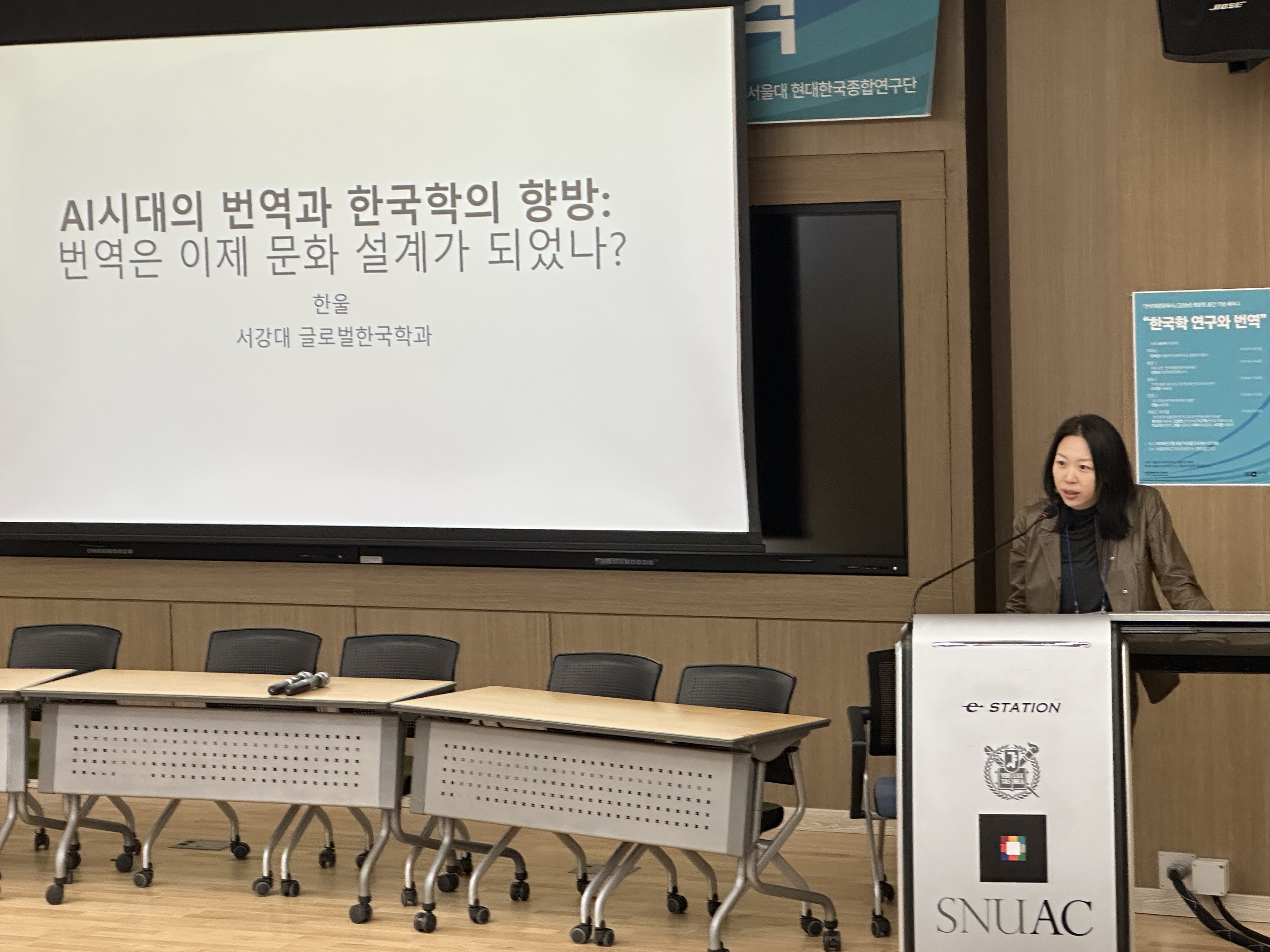
Professor Oul Han (Sogang Univ.) examined changes in translation paradigms under the theme "Translation in the AI Era and the Direction of Korean Studies." Professor Han diagnosed that translation has evolved from the stage where fan translations acted as emotional intermediaries, through the period of standardization in Machine Translation (MT), to the current era of Generative AI. He specifically pointed out that while AI translation internalizes context based on learned norms, it risks producing an unexplained "standardization of the median." Therefore, he argued that future challenges will shift from "what to translate" to "what kind of Korea is being represented by AI," asserting that the 'human agency' of researchers who combine fan expertise with academic knowledge will become increasingly vital.
In the final session, the Roundtable, vivid voices from the fields of Korean Studies and popular culture education were shared. Professors Gyu Tag Lee (George Mason Univ. Korea) and Younghan Cho (HUFS) noted the continued lack of English texts related to Korean Studies in overseas universities and raised the necessity for high-quality Korean works to be actively translated. Professor Sojeong Park (Hanyang Univ.) cautioned against anachronistic discourses that explain Korea through fragmented concepts like 'jeong' (affection) or 'heung' (excitement), emphasizing the importance of updating knowledge. Professor Hana Lee (SNU) mentioned that strategic writing and translation aimed at foreign readers, considering the differences within academic systems, could serve as an alternative.
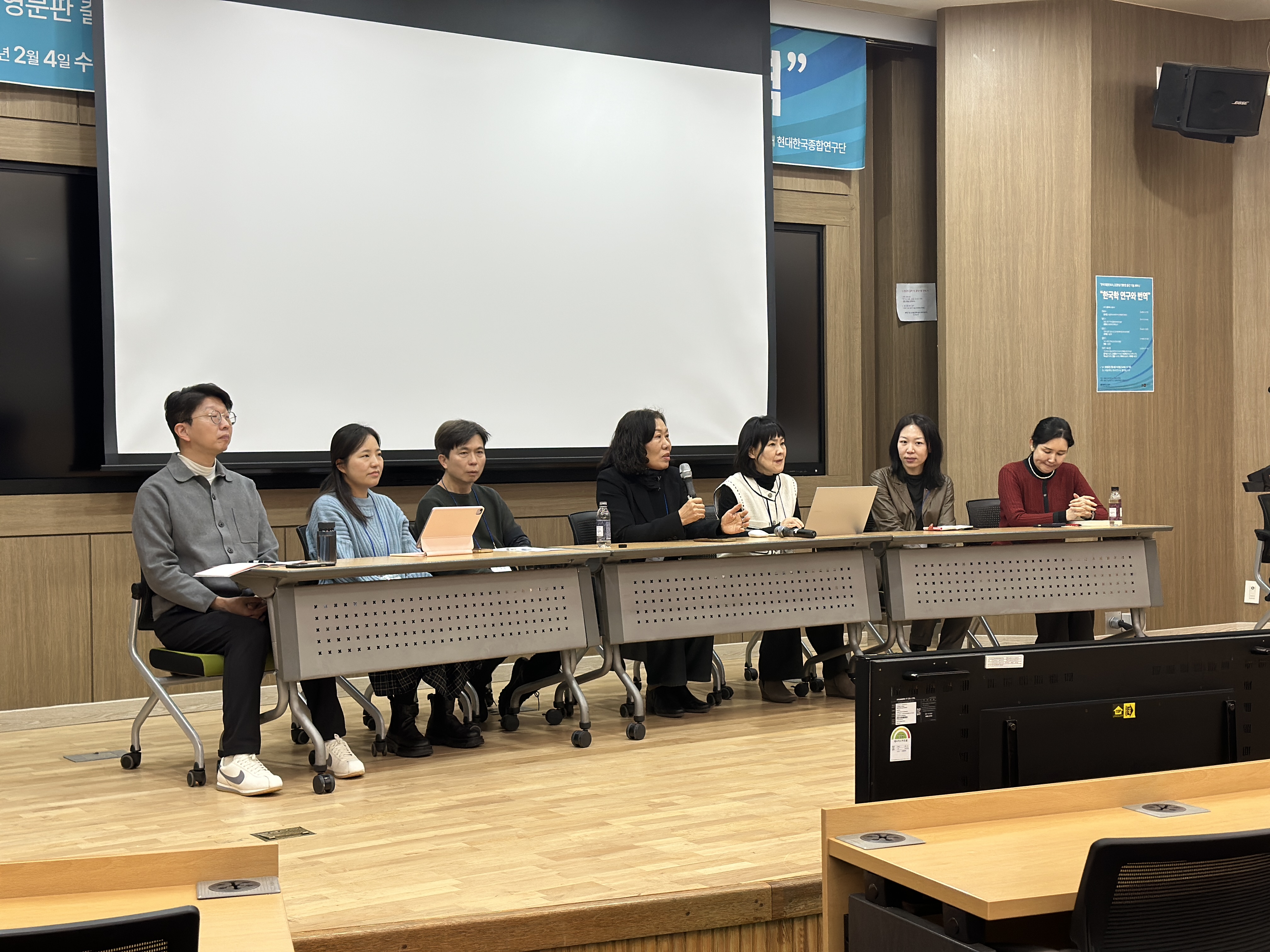
During the floor discussion, heated debates continued regarding the expansion of materials to understand the overall history of Korean popular culture beyond the Hallyu phenomenon, the standardization of terminology, and the scalability of archiving. This seminar served as a meaningful occasion to confirm how Korean popular culture research can acquire global universality through the medium of translation and broaden the horizons of future Korean Studies.